Questions 1-5: Choose the correct letter, A, B, C or D.
Two scientists consider the origins of discoveries and other innovative behavior
Scientific discovery is popularly believed to result from the sheer genius of such intellectual stars as naturalist Charles Darwin and theoretical physicist Albert Einstein. Our view of such unique contributions to science often disregards the person’s prior experience and the efforts of their lesser-known predecessors. Conventional wisdom also places great weight on insight in promoting breakthrough scientific achievements, as if ideas spontaneously pop into someone’s head – fully formed and functional.
There may be some limited truth to this view. However, we believe that it largely misrepresents the real nature of scientific discovery, as well as that of creativity and innovation in many other realms of human endeavor.
Setting aside such greats as Darwin and Einstein – whose monumental contributions are duly celebrated – we suggest that innovation is more a process of trial and error, where two steps forward may sometimes come with one step back, as well as one or more steps to the right or left. This evolutionary view of human innovation undermines the notion of creative genius and recognizes the cumulative nature of scientific progress.
Consider one unheralded scientist: John Nicholson, a mathematical physicist working in the 1910s who postulated the existence of ‘proto-elements’ in outer space. By combining different numbers of weights of these proto-elements’ atoms, Nicholson could recover the weights of all the elements in the then-known periodic table. These successes are all the more noteworthy given the fact that Nicholson was wrong about the presence of proto-elements: they do not actually exist. Yet, amid his often fanciful theories and wild speculations, Nicholson also proposed a novel theory about the structure of atoms. Niels Bohr, the Nobel prize-winning father of modern atomic theory, jumped off from this interesting idea to conceive his now-famous model of the atom.
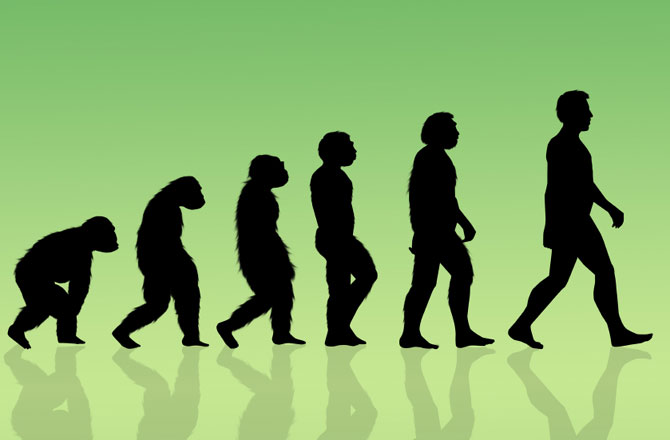
What are we to make of this story? One might simply conclude that science is a collective and cumulative enterprise. That may be true, but there may be a deeper insight to be gleaned. We propose that science is constantly evolving, much as species of animals do. In biological systems, organisms may display new characteristics that result from random genetic mutations. In the same way, random, arbitrary or accidental mutations of ideas may help pave the way for advances in science. If mutations prove beneficial, then the animal or the scientific theory will continue to thrive and perhaps reproduce.
Support for this evolutionary view of behavioral innovation comes from many domains. Consider one example of an influential innovation in US horseracing. The so-called ‘acey-deucy’ stirrup placement, in which the rider’s foot in his left stirrup is placed as much as 25 centimeters lower than the right, is believed to confer important speed advantages when turning on oval tracks. It was developed by a relatively unknown jockey named Jackie Westrope. Had Westrope conducted methodical investigations or examined extensive film records in a shrewd plan to outrun his rivals? Had he foreseen the speed advantage that would be conferred by riding acey-deucy? No. He suffered a leg injury, which left him unable to fully bend his left knee. His modification just happened to coincide with enhanced left-hand turning performance. This led to the rapid and widespread adoption of riding acey-deucy by many riders, a racing style which continues in today’s thoroughbred racing.